Signs a Retaining Wall Is Failing
Leaning, cracking, bulging, or poor drainage behind the wall? Learn the early warning signs of retaining wall failure and the safety risk.
You might not notice a subtle shift in your landscaping until a heavy rain exposes a major problem. We founded Wichita Foundation Solutions with a simple mission to provide exceptional foundation repair and waterproofing services that customers can count on.
Spotting the early signs retaining wall failing is the absolute best way to save the structure and protect your property. Our crews see these issues daily across Kansas, and the data clearly shows that these barriers fail from behind long before the face actually crumbles.
Recent 2026 market analysis reveals that major structural replacements can cost upwards of $15,000, making early intervention critical.
We will break down the specific visual clues of movement and walk through the exact steps to stabilize your yard. Let us look at the facts and explore a few practical ways to respond.
Six warning signs
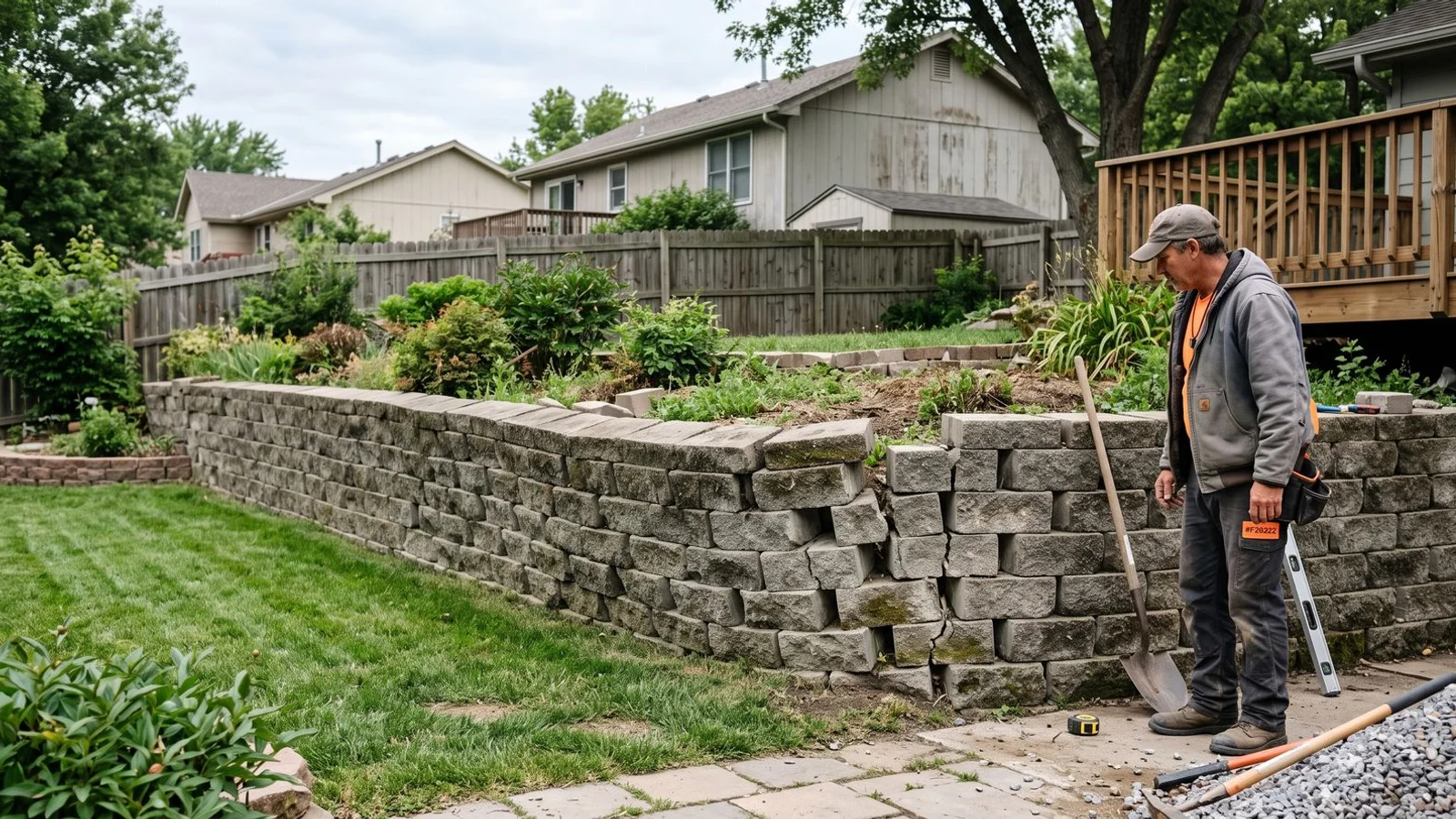
The six main warning signs of a failing retaining wall include visible leaning, bulging, face cracks, separated capstones, adjacent structure gaps, and poor drainage. When a wall starts to fail, the breakdown always begins behind the blocks rather than on the visible face.
Our inspectors check for these specific indicators to measure exactly how much stress the barrier is taking. Spotting these visual clues early allows you to stabilize the system before it requires a complete replacement.
- Visible lean. The wall is no longer vertical and tilts forward at the top. Structural engineers consider a lean exceeding just one percent of the total height to be a critical failure indicator requiring immediate action.
- Bulging. The face bows outward at midheight, meaning the blocks are bending under lateral pressure. This indicates the system is actively on the way to failure.
- Cracks in the face. Horizontal cracks in a concrete structure, opening joints in a block layout, or splitting stone all point to severe overload.
- Efflorescence and standing water. A wet zone at the top of the barrier indicates drainage is failing. White powdery mineral deposits on the block face also prove that trapped water is forcing its way through the masonry.
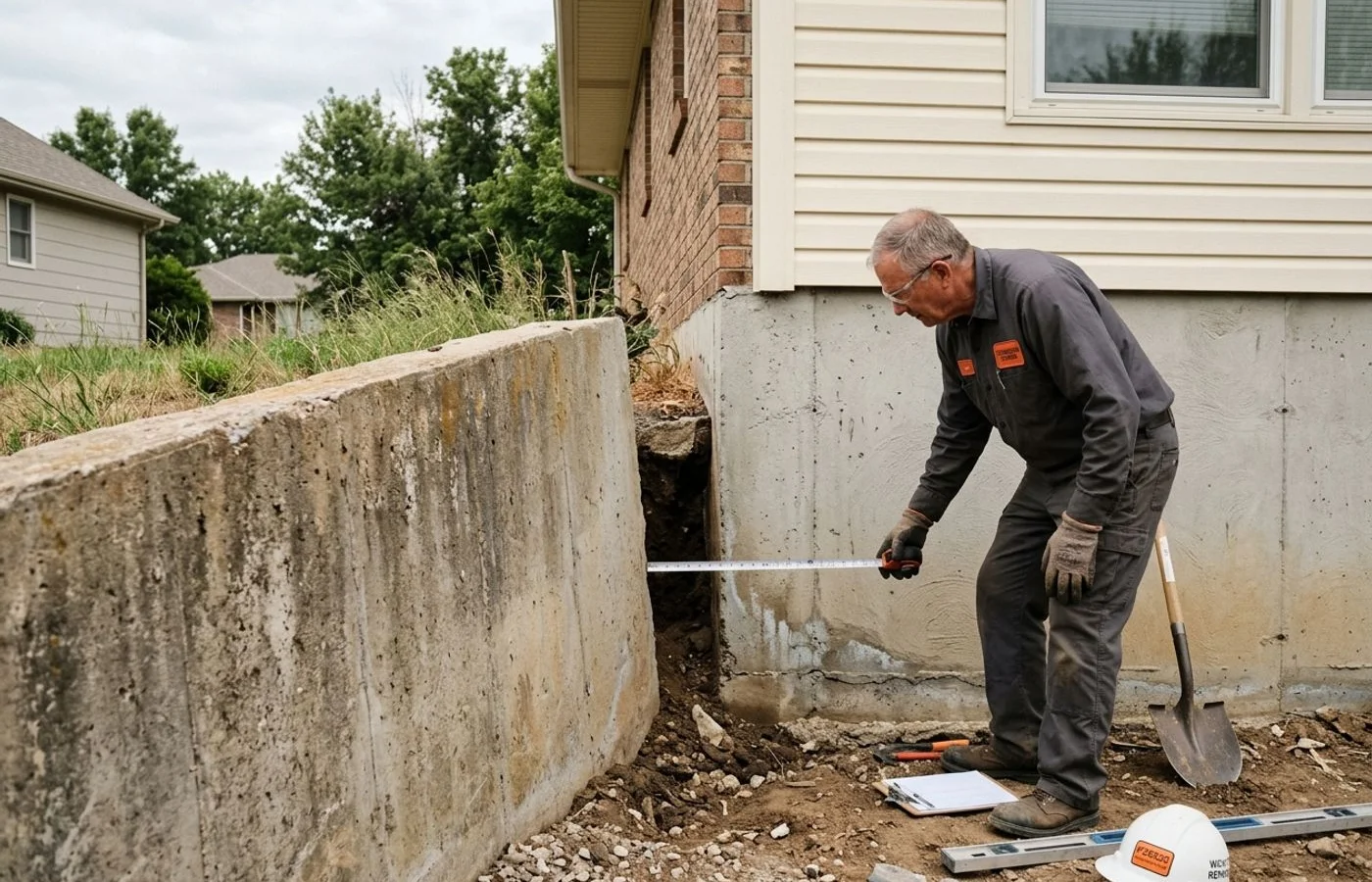
- Separation from adjacent structures. A gap opening between the blocks and a patio or house foundation means one part of the assembly is moving separately from the other.
- Cap stones pulling apart. The top layer is often the first place displacement shows because there is no confining load above it to hold the blocks together.
Any two of these indicators together is a strong signal that the structural integrity is compromised.
We recommend scheduling an inspection immediately if you notice a single severe warning sign like a rapid, visible lean. Catching these problems early saves money and prevents dangerous collapses.
Why walls fail
Walls fail primarily because trapped water and expanding soil create massive horizontal forces that push against the back of the structure. Almost every retaining wall failure in south-central Kansas comes back to these two distinct pressures.
We see these exact same forces cracking basement foundations all across the region. The outdoor version is arguably worse because most residential retaining walls are less heavily reinforced than a house foundation.
- Hydrostatic pressure. Water builds up in the soil without a proper exit path. 2026 engineering data confirms that this trapped water adds immense direct lateral load to whatever the soil is already pushing, making it the leading cause of structural collapse.
- Expansive clay swelling. Wet clay expands forcefully when saturated. Behind a confining barrier, that swelling turns into a direct horizontal load the system was simply not designed to handle.
For a detailed look at how this mechanism works, see why retaining walls lean or bow in Kansas.
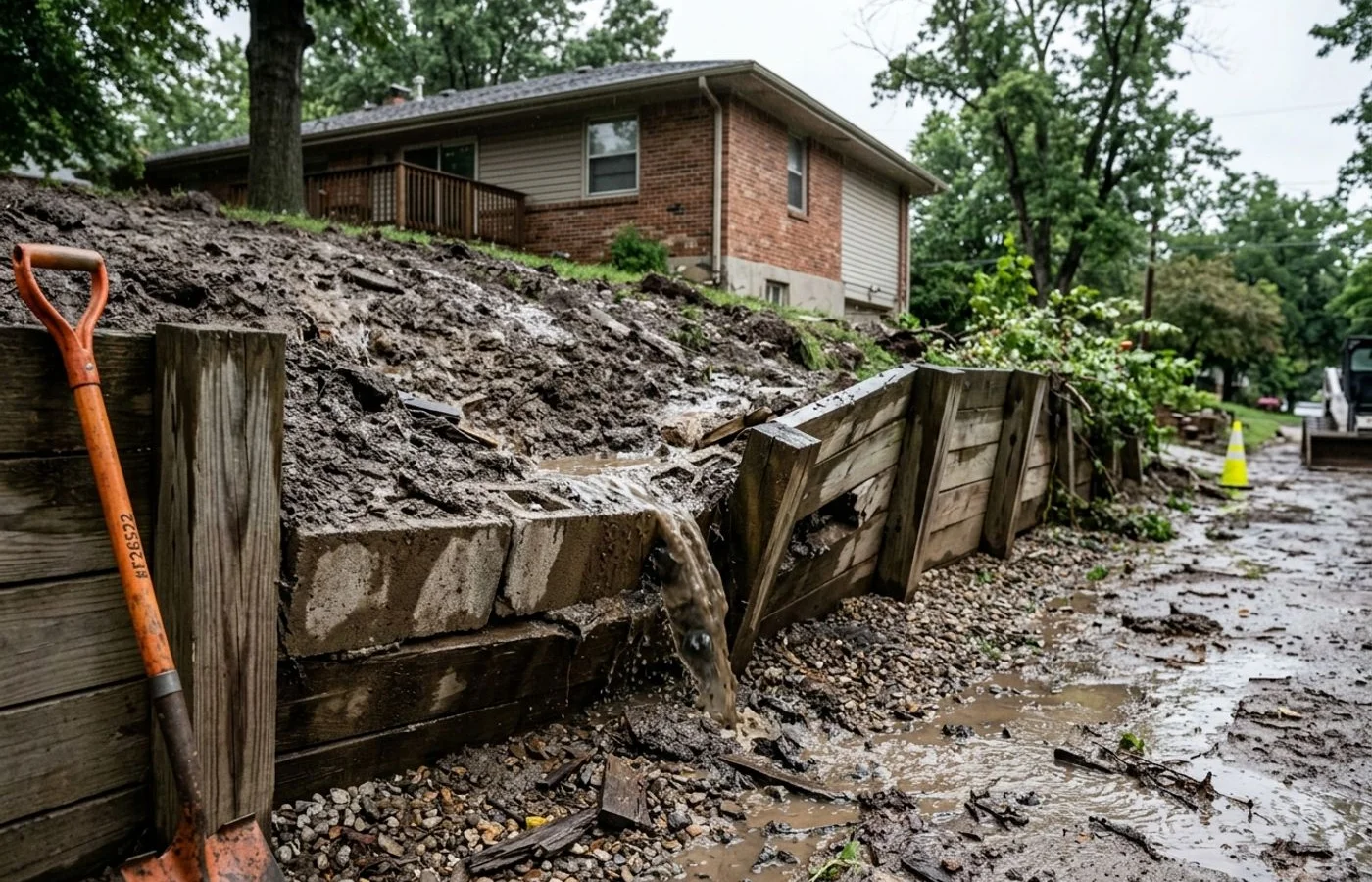
Our teams frequently fix yards where basic drainage was completely left out of the original construction. You cannot stop the rain, but you can control how the water moves through your property.
The safety concern
Retaining walls pose a serious safety hazard when they fail because a sudden collapse can send tons of soil and heavy masonry crashing into active living spaces. A retaining wall does not always fail gracefully, and the final break is often immediate and destructive.
We urge homeowners to take any visible movement seriously. Once a wall moves past a certain tipping point, the lateral load completely overcomes the block friction.
That sudden shift matters deeply because these structures typically hold up critical areas of your property.
- Slopes near walkways
- Slopes near driveways
- Slopes above patios or seating areas
- Slopes near foundations
A sudden collapse into any of those spaces puts your family at risk and creates a massive financial burden.
Our recent reviews of 2026 landscape construction costs show that cleaning up a failure and building a new structural wall can easily range from $15,000 to $25,000. If your property is showing any signs retaining wall failing, do not delay a professional assessment.
Delaying the fix only allows the soil pressure to compound and worsen.
What to check yourself
You can perform a quick visual assessment yourself by checking the wall face, the top drainage, the joints, and any adjacent concrete structures. Catching retaining wall problems early only takes a few minutes but provides vital clues about the health of your yard.
We recommend doing this check twice a year, especially after the heavy spring rains. Look closely at these specific areas to spot the early indicators of failure.
| Inspection Area | What to Look For | Urgency Level |
|---|---|---|
| The Wall Face | Sight down the blocks. Look for leaning, bulging, or white powdery mineral deposits (efflorescence). | High. Any visible lean over one percent requires evaluation. |
| The Top Edge | Walk the top of the line. Look for standing water, low spots, or vegetation stressed by drainage problems. | Moderate to High. This indicates trapped hydrostatic pressure. |
| The Block Joints | Check the connections. Look for opening cracks or lateral displacement between the stones. | Moderate. The wall is shifting and losing its structural lock. |
| Adjacent Structures | Check the transitions. Look for gaps developing at the wall-to-structure connections, like a separating patio. | High. The soil mass is actively moving away from the house. |
Note when the movement actually appeared on your property.
Our experience shows that sudden new movement after a wet spring is significantly more urgent than very slow shifting over several years. Keep a photo record of any cracks on your phone so you can track the changes over time.
What comes after inspection
After an inspection confirms the retaining wall is moving, the response involves stabilization, a partial rebuild, or a full replacement. When the soil is pushing the structure, we scope one of three specific repair paths based on the damage severity.
Our engineers look at the base integrity first to see if the structure can be saved. National repair data from 2026 shows that catching the problem early keeps repair costs much lower than waiting for a total collapse.
- Stabilization with heavy-duty wall anchors, tiebacks, and proper drainage correction to hold the existing blocks in place.
- Combined stabilization and partial rebuild where the top section is failing but the buried base foundation remains completely sound.
- Full rebuild where the structure is too far gone and poses an immediate safety hazard.
Details on the exact repair approaches and the hardware utilized are in our retaining wall service page.
We always provide a clear explanation of which method fits your specific yard and budget. Choosing the right repair method restores the safety and usable space of your property.
Free retaining wall inspection
If you are dealing with a leaning retaining wall, cracking stones, or any of the structural warning signs above, book a free on-site look. This professional assessment is the fastest way to understand exactly what is happening beneath the soil.
Our technicians will measure the exact deflection and check the drainage routes around your property. Book through our retaining walls service or call (316) 613-4575 to get started.
We make the scheduling process easy so you can get answers quickly. Do not let a small shift turn into a devastating yard collapse. Act now to protect your landscaping investment.