French Drains vs Surface Drains vs Land Grading
Which drainage solution fits your yard? Compare French drains, surface drains, and land grading and when to combine them in Wichita.
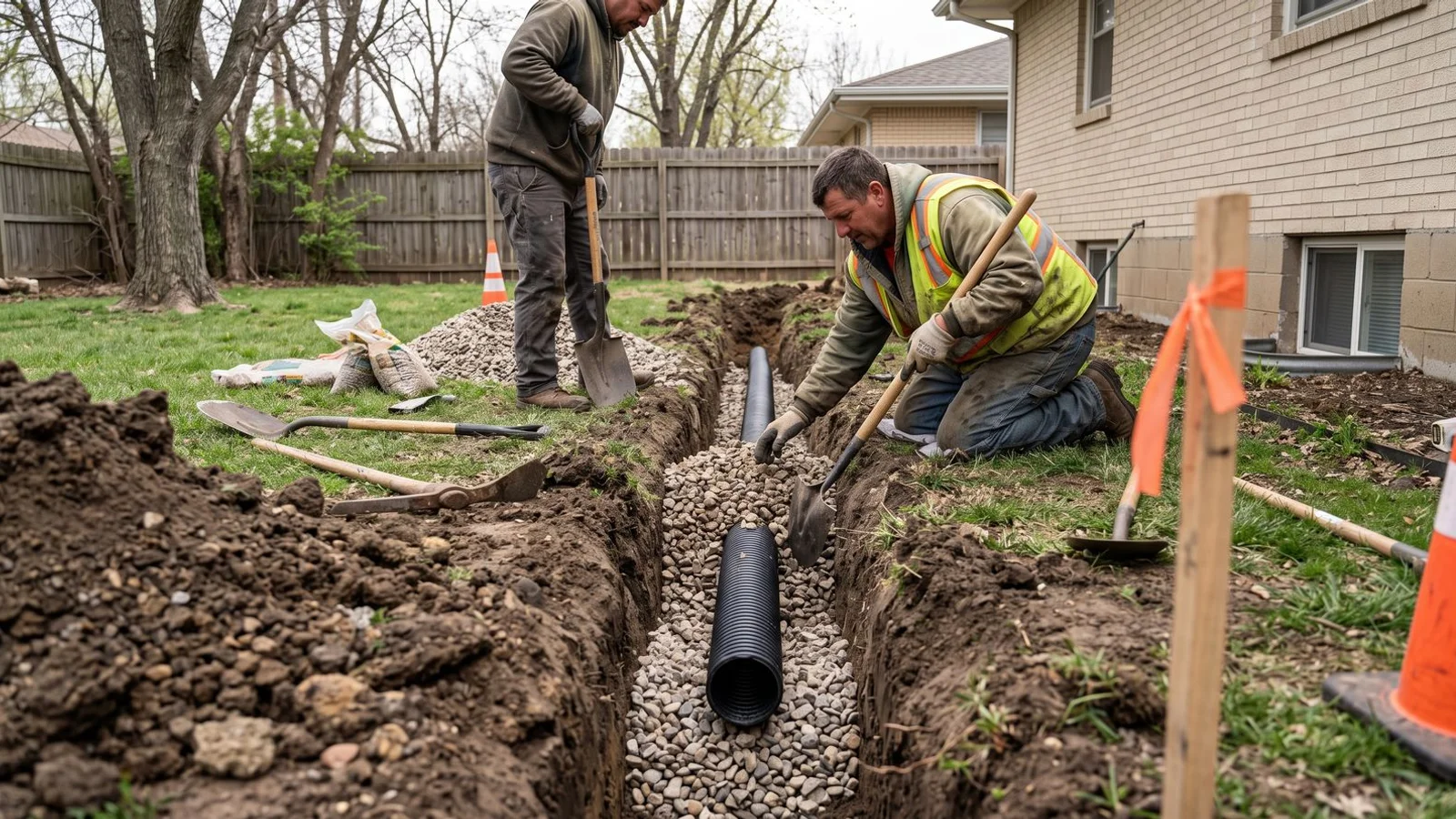
At Wichita Foundation Solutions, we often see homes struggle against the intense spring storms typical of south-central Kansas. Heavy rainfall quickly exposes the weak points in a property’s defense system. You know the frustration of watching a sudden downpour turn a functional lawn into a muddy swamp.
Finding the right solution means comparing french drain vs surface drain systems against traditional grading.
The right fix on any given lot is usually a combination of tools.
We are going to break down these three main yard drainage options.
Let us look at what each does and when a specific method is the right choice for your home.
Land grading
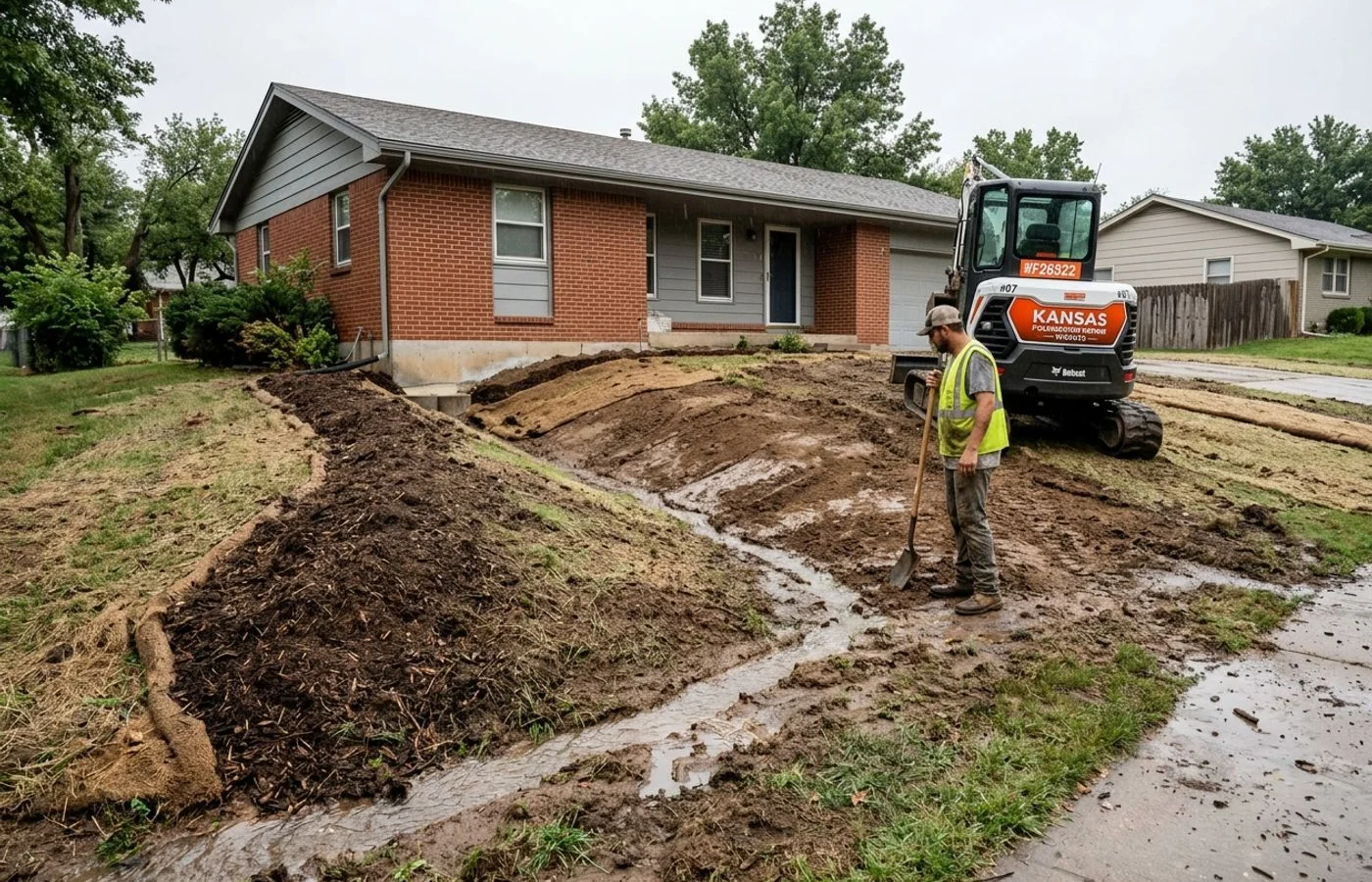
Regrading changes the shape of the ground so surface water flows exactly where you want it to go. This approach is the fundamental tool for land grading drainage because it moves the largest volume of water for the lowest cost.
According to the 2024 International Residential Code (IRC), a proper grade requires a minimum slope of six inches within the first ten feet away from the foundation. Meeting this exact standard prevents water from pooling against your basement walls and causing hydrostatic pressure.
How it works: We cut swales, adjust slopes, and shape the earth so runoff moves away from the house toward a safe street outlet or storm sewer. Sometimes this requires a subtle regrade of a single low spot in the turf. Other times, the project demands a full swale system carved across an entire yard to manage heavy neighborhood runoff.
Best for:
- Low spots that hold water for hours after a heavy rain.
- Ground that slopes back toward the house instead of away from it.
- Areas where surface water needs a defined, fast-moving path to the street.
- Fixing the surface flow near downspout terminations.
Limits:
- Cannot help where the water is already trapped subsurface.
- Will not solve pooling from an over-saturated clay soil column.
- Needs enough natural vertical fall to work effectively.
Regrading is often step one on any comprehensive drainage plan. If moving the dirt permanently solves the issue, our team skips the pipe installation entirely.
French drains
A French drain is a buried, perforated pipe surrounded by washed gravel and tightly wrapped in a commercial-grade filter fabric. This subsurface trench collects ground moisture and routes it to a safe outlet away from your structure.
Our crews typically use rigid Schedule 40 PVC pipe rather than flexible corrugated tubing. Rigid PVC resists crushing under soil weight and allows for easy cleaning with a standard plumber’s snake if tree roots ever intrude.
How it works: The entire trench acts as a giant sponge to collect subsurface water along its full length. The perforated pipe carries this collected water rapidly downstream via gravity. We wrap the system in a heavy-duty non-woven geotextile fabric to prevent fine Kansas clay from clogging the gravel over time.
Best for:
- Chronic wet zones where surface grading alone does not solve the underlying issue.
- Water tracking slowly through the soil toward a basement foundation.
- Yards where surface drainage runs fine but the ground itself stays heavily saturated.
- Long linear problem areas, like against the back of a house or along a concrete driveway edge.
Limits:
- More expensive per linear foot than basic dirt grading.
- Requires an endpoint outlet with sufficient downhill fall.
- Needs periodic monitoring to ensure roots or fine silt are not causing blockages.
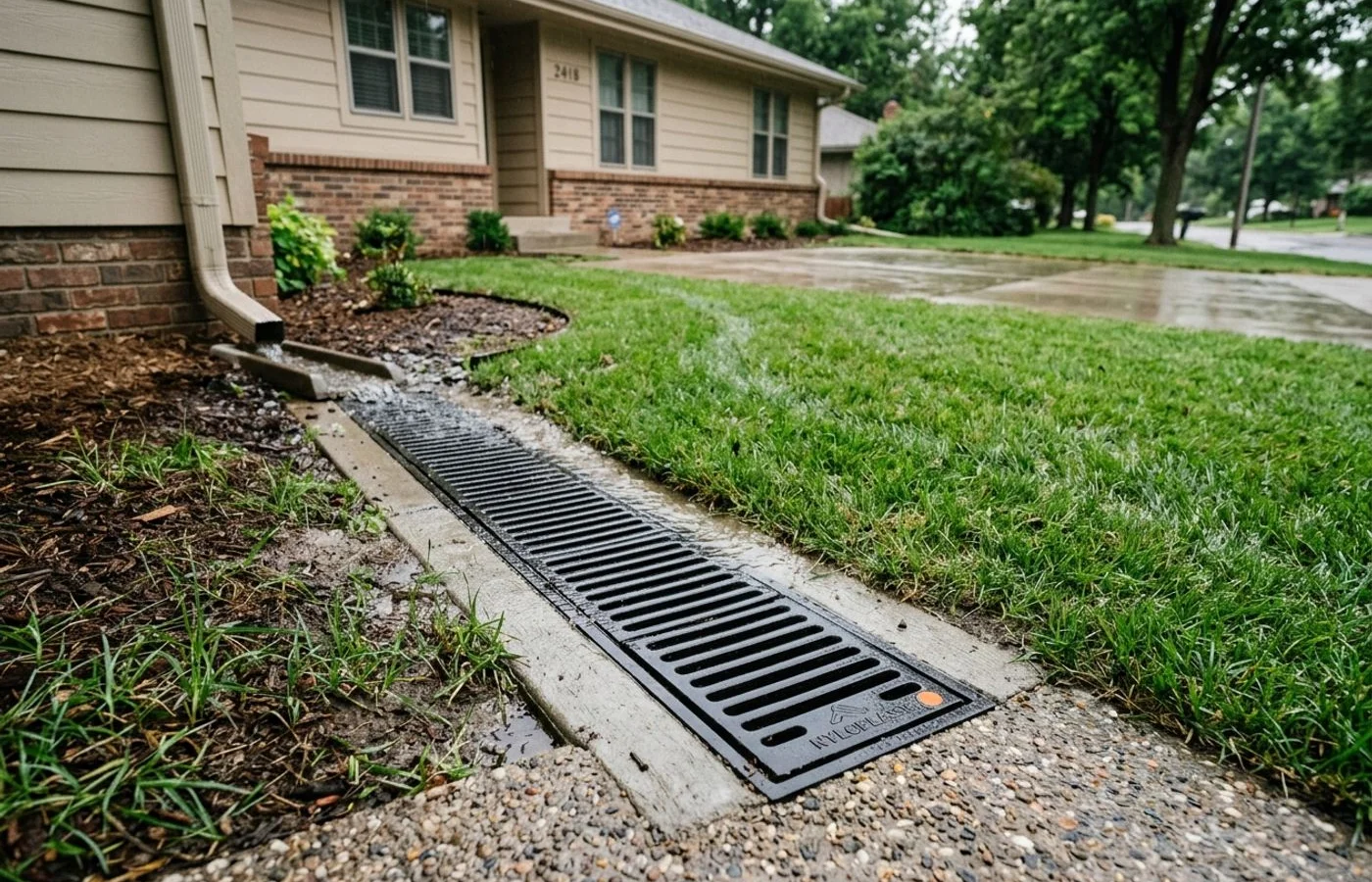
Surface drains
A surface drain is a grate set flat at ground level that catches pooling water and routes it through a solid pipe to a safe discharge zone. This is a highly effective, targeted solution for fast-accumulating surface water on your property.
We frequently install NDS 12-inch catch basins for heavy residential runoff. A standard four-inch pipe connected to this basin easily handles over 100 gallons of water per minute during severe Midwestern downpours.
How it works: The durable plastic or metal grate covers a deep catch basin set directly into the soil. Water flows across the surface directly into the grate, drops into the basin, and quickly exits through the smooth outlet pipe. The basin itself features a sump area at the bottom that traps leaves and heavy dirt before they can enter and clog the main line.
Best for:
- Low spots that cannot be regraded, such as patio corners or enclosed pool decks.
- Downspout termination points that must feed directly into an underground pipe system.
- Chronic ponding at specific, defined locations in the turf.
- Retrofits in mature landscapes where heavy excavation is limited.
Limits:
- Only catches water that actively flows over the top of the grate.
- Can clog rapidly if leaves and yard debris are left sitting on the cover.
- Needs a downstream outlet with steady vertical fall.
When we combine them
Most effective drainage plans in the Wichita metro area use two or three of these tools working together. A hybrid approach ensures your property stays dry regardless of whether the water is flowing over the grass or seeping through the dirt.
Our typical installation plan targets both visible runoff and hidden moisture. Recent industry data shows that nearly 80 percent of homes with severe water issues require a blended strategy to achieve total protection.
A typical combination plan includes:
- Regrade the yard for the bulk of the fast-moving surface flow.
- Extend downspouts directly into buried, solid PVC drain pipes.
- Add a surface drain at any hardscape low spot that cannot be regraded.
- Install a French drain along a chronic wet zone or right against a vulnerable foundation footing.
That multi-layered combination handles massive surface storms with strategic grading and catch basins. The French drain then quietly manages the lingering subsurface flow that neither of the other approaches can touch.
What we do not recommend
Avoiding common installation mistakes is just as critical as choosing the correct drainage hardware. Poorly planned systems waste money and often push water closer to your vulnerable basement walls.
We routinely tear out failed DIY projects where the basic principles of gravity and soil mechanics were completely ignored. The following scenarios are guaranteed ways to cause a system failure.
Common drainage mistakes to avoid:
- Building a French drain where basic land regrading alone would solve the problem. That is an expensive, unnecessary overkill.
- Regrading a yard where the water issue is entirely trapped underground. Pushing topsoil around will never touch a deep subsurface problem.
- Installing a surface drain without a clear, downhill outlet pipe. This mistake simply moves a puddle from one bad spot to another.
- Approving any drainage plan that ignores roof gutters. Managing downspout water is the single easiest fix on any property.
Cost, roughly
Grading is usually your lowest cost option per square foot, while custom pipe installations require a larger upfront investment. The final price tag depends heavily on total length, depth of the trench, and the presence of existing hardscape.
Recent 2026 industry averages for professional installation highlight the clear price differences between these yard drainage options.
| Drainage Solution | Average Cost | Cost Factor |
|---|---|---|
| Land Grading | $1.50 - $3.00 | Per square foot |
| French Drains | $25 - $50 | Per linear foot |
| Surface Drains | $300 - $600 | Per catch basin |
Every single one of these fixes is far cheaper than the massive structural restoration that untreated yard flooding eventually causes. The average residential foundation repair bill now exceeds $5,500 across the United States.
See our poor drainage and foundation guide for a complete breakdown of that math.
Free on-site assessment
Show our technicians the exact spot where water is pooling, and we will scope the smallest combination of grading and pipe that permanently solves the issue.
You do not need to guess which system is right for your specific soil type.
We will design a custom solution that protects your property without selling you unnecessary hardware.
Book a consultation directly through our yard drainage service page or call (316) 613-4575 to get started today.